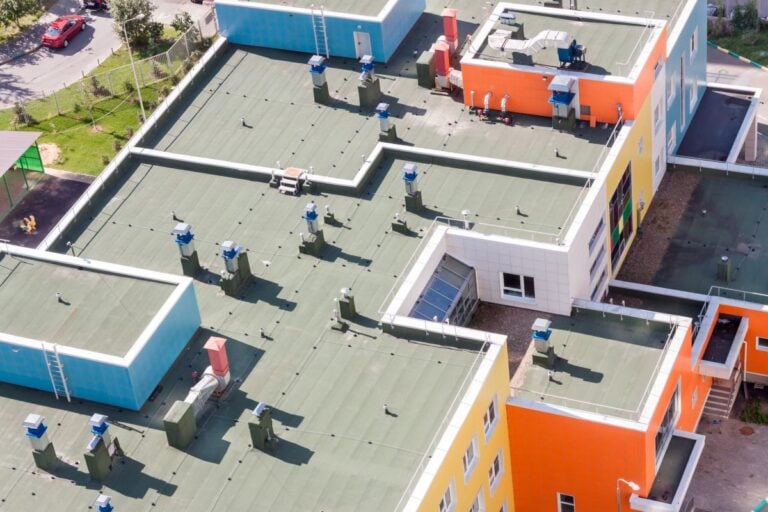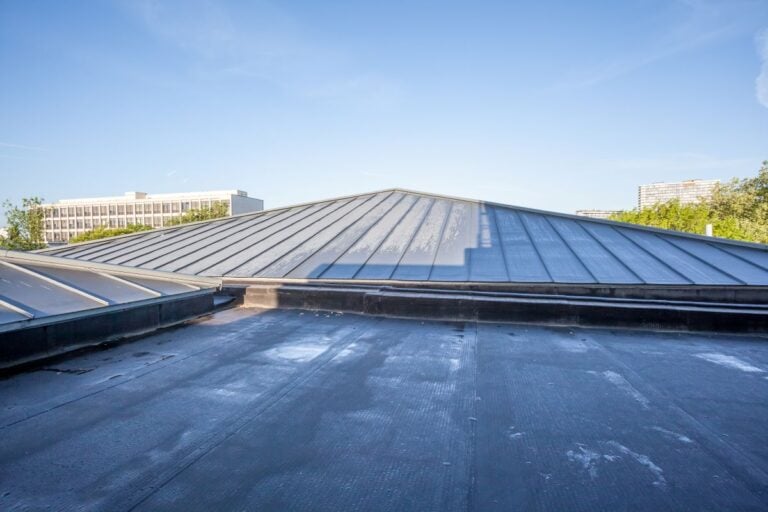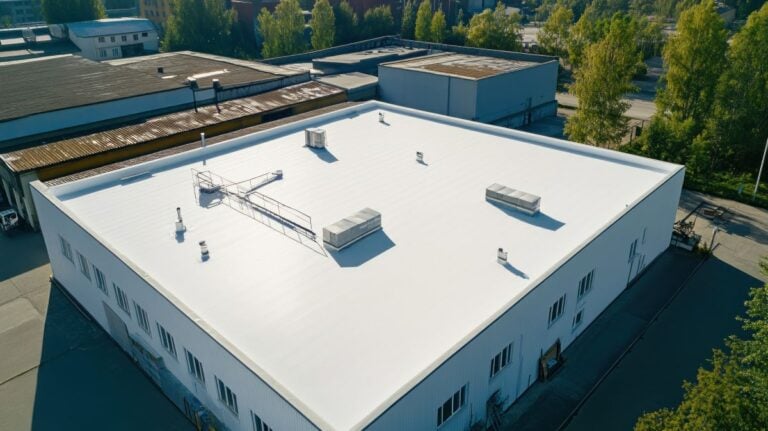
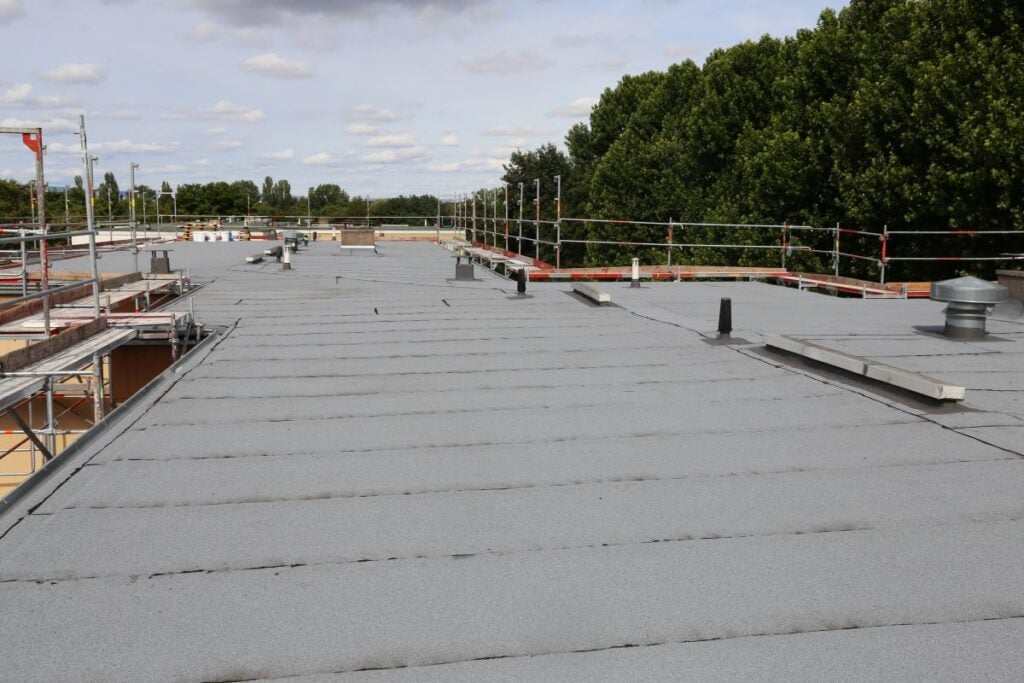
The honest answer to “how long does a commercial flat roof last” depends heavily on what material was installed and how well it’s been maintained, with typical service lives ranging from 15 years on the low end to 40+ years on the high end. Property owners and facility managers in Arlington and surrounding areas often ask this question when planning capital budgets or evaluating whether an aging roof still has service life left. Getting the numbers right matters because premature replacement wastes capital, while waiting too long to replace risks damage that costs multiples of what the new roof would have. This guide walks through the realistic lifespan of each major commercial flat roof material, what actually determines whether a roof hits the low or high end, and what warning signs signal replacement is coming.
- Lifespan by material: 15 to 40+ years depending on membrane type and maintenance.
- What determines it: Installation quality, maintenance program, climate, and rooftop use all factor in.
- When to plan: Replacement planning typically starts at 75% of expected service life.
Why Commercial Flat Roof Lifespans Vary So Widely
Two flat roofs installed on the same day, on similar buildings, can reach end of life 10 years apart depending on how they’re used and maintained. Understanding what drives that variation helps property owners plan accurately.
What’s the Real Difference Between Best-Case and Worst-Case Lifespans?
The real difference between best-case and worst-case commercial flat roof lifespans can be 15 years or more on the same membrane type, and it comes down to installation quality, maintenance frequency, and rooftop conditions. A well-installed TPO roof with twice-yearly professional maintenance and controlled rooftop traffic can hit 30 years, while a poorly-installed TPO roof with clogged drains and heavy foot traffic may fail at 15. Ponding water is the single largest cause of premature failure across all flat roof types, followed by seam degradation and detail flashing issues at penetrations. Property owners in Arlington and surrounding areas planning around lifespan should treat published ranges as ranges, not point estimates. The specific building’s history matters more than any published lifespan number.
- Installation quality: Wide variation in how well systems are installed.
- Maintenance frequency: Documented programs extend lifespan by years.
- Ponding water: Single largest cause of premature membrane failure.
- Rooftop traffic: HVAC service and equipment installation stress membranes.
How Does Installation Quality Affect Long-Term Performance?
Installation quality accounts for a huge share of the difference between roofs that hit their full service life and roofs that fail early. The National Roofing Contractors Association estimates that up to 40% of roofing issues result from improper installation. On flat roofs specifically, common installation problems include improperly welded TPO or PVC seams, EPDM seams sealed with poor adhesive coverage, flashing details that don’t provide the required overlap at walls and penetrations, and insulation attachment that doesn’t meet manufacturer requirements. Once installed, these issues don’t fix themselves; they just wait to become leaks. Manufacturer-certified installers deliver dramatically better outcomes than uncertified contractors on the same materials.
- Seam welding: TPO and PVC seams are the most common failure point.
- Flashing details: Wall and penetration flashings require specific installation techniques.
- Insulation attachment: Wrong pattern or fasteners cause thermal bridging.
- Manufacturer certification: Certified installers deliver better outcomes.
4 Commercial Flat Roof Materials and Their Real Lifespans
Four main flat roof materials cover the vast majority of commercial buildings. Each has a distinct expected lifespan and set of factors that push toward the higher or lower end of that range.
1. TPO (Thermoplastic Polyolefin) – 20 to 30 Years
TPO is the most popular commercial flat roof material in North America, capturing more than 40% of new commercial installations. TPO lifespan runs 20 to 30 years for quality installations with proper maintenance, with the higher end reserved for 60-mil or 80-mil membranes on well-maintained buildings. TPO’s white reflective surface delivers real energy savings in warmer climates and meets cool roof requirements without extra coatings. Heat-welded seams create a monolithic bond that’s stronger than the membrane itself when done right, which is TPO’s biggest structural advantage. Buildings in Arlington and surrounding areas with TPO roofs typically reach the middle to high end of the lifespan range because the mid-Atlantic climate is neither punishingly hot nor extremely cold.
- Standard lifespan: 20 to 30 years with proper maintenance.
- Membrane thickness: 60-mil and 80-mil last longer than 45-mil.
- Cool roof performance: White surface reduces cooling costs.
- Seam integrity: Heat-welded seams are TPO’s core durability feature.
2. EPDM (Ethylene Propylene Diene Monomer) – 25 to 35 Years
EPDM is the second most popular commercial flat roof material and has a track record spanning more than 50 years, giving it the longest real-world performance data of any single-ply system. EPDM lifespan runs 25 to 35 years for quality installations, with some documented systems reaching 40 years or more when properly maintained. EPDM’s rubber composition handles temperature extremes and freeze-thaw cycles better than most other materials, which matters in Arlington and surrounding areas where winter cold and summer heat both stress roofing. The main downside is that EPDM seams are adhesive-bonded rather than heat-welded, which historically makes them somewhat more prone to seam failure than TPO or PVC. Modern EPDM systems use factory-applied seam tape that has significantly closed this gap.
- Standard lifespan: 25 to 35 years, often longer with maintenance.
- Track record: 50+ years of real-world performance data.
- Temperature tolerance: Excellent for freeze-thaw climates.
- Seam type: Adhesive-bonded, requiring careful application.
The Single Ply Roofing Industry (SPRI), the trade association representing commercial single-ply membrane manufacturers, notes that single-ply roofing has grown to dominate the North American low-slope commercial market due to its long service life, dependability, and ease of installation, with EPDM, TPO, and PVC systems collectively making up the vast majority of new commercial flat roof installations across the industry.
3. PVC (Polyvinyl Chloride) – 25 to 30 Years
PVC commercial flat roofs run 25 to 30 years in typical installations, with premium systems reaching 35 years. PVC costs more than TPO or EPDM but delivers superior chemical resistance and fire performance, making it the standard choice for food service buildings, restaurants, and any facility with grease exhaust or chemical exposure. PVC’s heat-welded seams provide the same structural integrity advantage as TPO, and the material generally holds up better against acid rain, industrial pollution, and rooftop equipment leaks. Property managers in Arlington and surrounding areas with restaurants, industrial buildings, or facilities exposed to chemical fumes often find PVC the right choice despite the higher upfront cost.
- Standard lifespan: 25 to 30 years, up to 35 for premium systems.
- Chemical resistance: Handles grease, oil, and industrial pollution.
- Fire performance: Strong flame resistance ratings.
- Best applications: Restaurants, food service, industrial buildings.
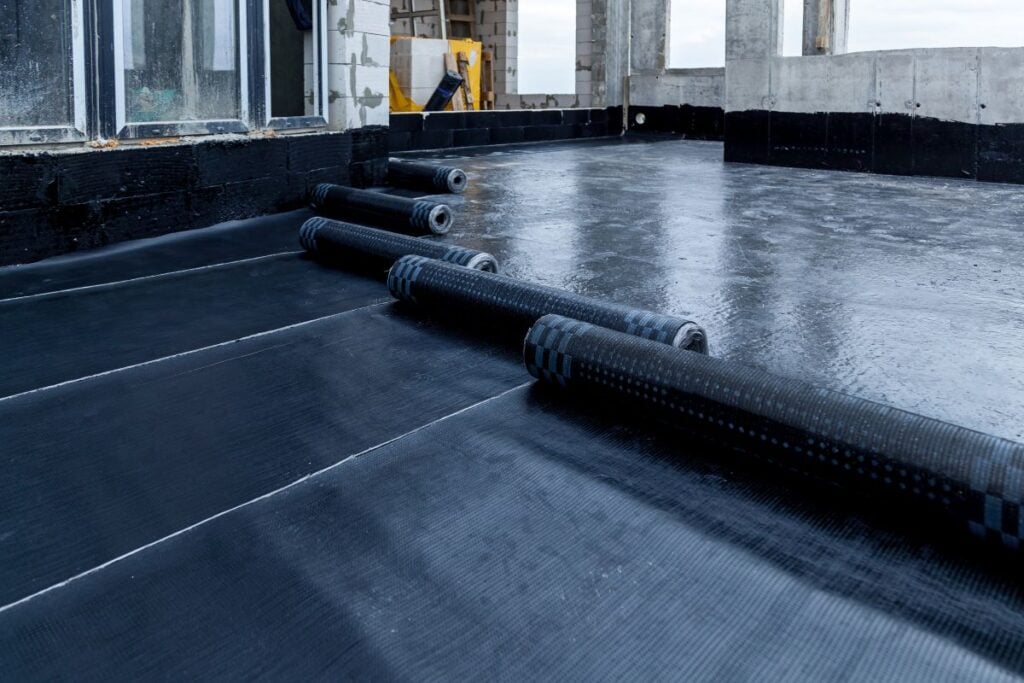
4. Modified Bitumen and Built-Up Roofing (BUR) – 15 to 30 Years
Modified bitumen and built-up roofing represent the traditional asphalt-based commercial roofing systems, with lifespans ranging from 15 to 30 years depending on the specific system, number of layers, and installation quality. Modified bitumen typically lasts 15 to 25 years, while multi-layer built-up roofs with proper gravel ballast can reach 30 years or more. These systems are heavier than single-ply membranes and require structural support to handle the load. They’re often chosen for larger commercial buildings where weight is not an issue, or for retrofits where the existing structure was designed for their weight. Buildings in Arlington and surrounding areas with mod-bit or BUR roofs benefit from careful maintenance because these systems are harder to repair than single-ply once damage spreads.
- Modified bitumen: 15 to 25 years typical.
- Built-up roofing (BUR): 20 to 30 years with proper maintenance.
- System weight: Heavier than single-ply, requires structural support.
- Repair complexity: Harder to patch than TPO or EPDM.
What Actually Determines Whether Your Roof Hits the Low or High End?
The published lifespan ranges are ranges for a reason, and specific factors determine where any individual roof lands. Knowing what to focus on helps owners get maximum service life.
What Extends a Commercial Flat Roof Beyond Its Expected Lifespan?
Commercial flat roofs extend beyond their expected lifespan when they have proper drainage, documented semi-annual maintenance, minimal rooftop traffic, protected walk pads around equipment, and prompt repair of small issues before they compound. Buildings with these characteristics regularly hit the top of published lifespan ranges. The single most important factor is drainage: roofs without ponding water outlast roofs with chronic pooling by 5 to 10 years across all material types. Second is documented maintenance, which catches small problems while they’re cheap to fix. Property owners in Arlington and surrounding areas who invest in these two areas typically see their roofs hit the upper end of published lifespans.
- Proper drainage: No ponding water beyond 48 hours after rain.
- Documented maintenance: Semi-annual professional inspections at minimum.
- Controlled foot traffic: Walk pads in HVAC service areas.
- Prompt repairs: Small issues addressed before they spread.
What Shortens Commercial Flat Roof Lifespan Fastest?
The fastest ways to shorten commercial flat roof lifespan are chronic ponding water, blocked drains, heavy uncontrolled rooftop traffic, delayed repairs after leaks, and equipment installations that puncture the membrane without proper flashing. Any of these can cut expected life by 5 to 15 years, and combinations can cut it in half. Chronic ponding is especially damaging because standing water accelerates membrane degradation, adds weight to the structure, and often reveals slope problems that need to be fixed at replacement time. Buildings with skipped maintenance and heavy tree cover often have all these problems compounding at once. Reputable contractors in Arlington and surrounding areas can identify these lifespan-shortening conditions during initial assessment.
- Chronic ponding: Cuts lifespan 5 to 10 years across all material types.
- Blocked drains: Root cause of most ponding problems.
- Uncontrolled traffic: HVAC service and equipment stress the membrane.
- Delayed repairs: Small problems compound into system failures.
Frequently Asked Questions
What’s the average lifespan of a commercial flat roof?
Commercial flat roofs typically last 20 to 30 years, with variation by material, installation quality, and maintenance. TPO and EPDM systems average 25 to 30 years, PVC 25 to 30 years, modified bitumen 15 to 25 years, and built-up roofs 20 to 30 years. Well-maintained roofs often exceed these ranges.
How can I tell if my commercial flat roof is near end of life?
Signs your commercial flat roof is near end of life include widespread ponding water that won’t drain, multiple leak locations, visible cracking or blistering across the membrane, seam separation, and repeated repair needs. When ongoing repairs approach 10% of replacement cost annually, replacement usually makes better financial sense.
Does a commercial flat roof need to be inspected every year?
Yes, commercial flat roofs should be professionally inspected at least twice per year, in spring and fall, with additional inspections after major storms. Older roofs (over 15 years) benefit from quarterly inspections. Documented inspections are also typically required to keep manufacturer warranties valid.
Can a commercial flat roof last 40 years?
Yes, well-installed and well-maintained commercial flat roofs can last 40 years or more, especially high-quality EPDM systems and built-up roofs with quality ballast. Reaching this lifespan requires proper installation, documented semi-annual maintenance, controlled rooftop traffic, and prompt repair of any issues that develop.
What’s the longest-lasting commercial flat roof material?
EPDM has the longest documented real-world track record among single-ply materials, with quality installations reaching 35 to 40 years or more. Built-up roofs with proper gravel ballast can also reach 30 years or longer. Metal roofing systems, though technically low-slope rather than flat, can last 40 to 70 years.
Should I replace my commercial flat roof or keep repairing it?
The rule of thumb is that when your commercial flat roof reaches 75% to 80% of its expected lifespan, or when annual repair costs exceed 10% of replacement cost, replacement usually makes better financial sense than continued repairs. A professional condition assessment can quantify remaining service life and help make the decision.
Choose Springfield Roofing & Sheet Metal for Commercial Flat Roof Assessments
When you’re planning around how long does a commercial flat roof last, honest assessments of your specific roof’s condition matter more than published lifespan ranges. Springfield Roofing & Sheet Metal is a 1st and 2nd generation family-owned and operated company serving Arlington and surrounding areas with a dedicated in-house crew, full labor and material warranties, and CertainTeed 5-Star Select Shingle Master certification. Our team assesses commercial flat roof condition honestly, gives property owners realistic remaining service life estimates, and helps plan capital budgets around replacement timing that makes financial sense. Contact Springfield Roofing & Sheet Metal today for a free commercial roof assessment and clear guidance on where your roof stands in its lifecycle.