A solid commercial roofing maintenance plan is the difference between a roof that delivers its full service life and one that fails years early, and most premature roof failures on commercial buildings trace back to maintenance that never happened. Property owners and facility managers in Manassas and surrounding areas often discover too late that a $500 sealant repair would have prevented a $50,000 leak, and that the manufacturer warranty they thought protected them was voided years earlier by missed inspections. Knowing what real preventive maintenance looks like, what it costs, and what it catches helps building owners protect their investment, their warranty, and their tenants. This guide breaks down what works, what to expect from a maintenance program, and what kinds of problems regular inspections actually prevent.
- What it covers: Scheduled inspections, drain clearing, sealant work, and documented repairs.
- What it costs: Typically $0.05 to $0.20 per square foot per year for a structured program.
- What it prevents: Premature replacement, voided warranties, and emergency leak damage.
Why Commercial Roofs Fail Earlier Than They Should
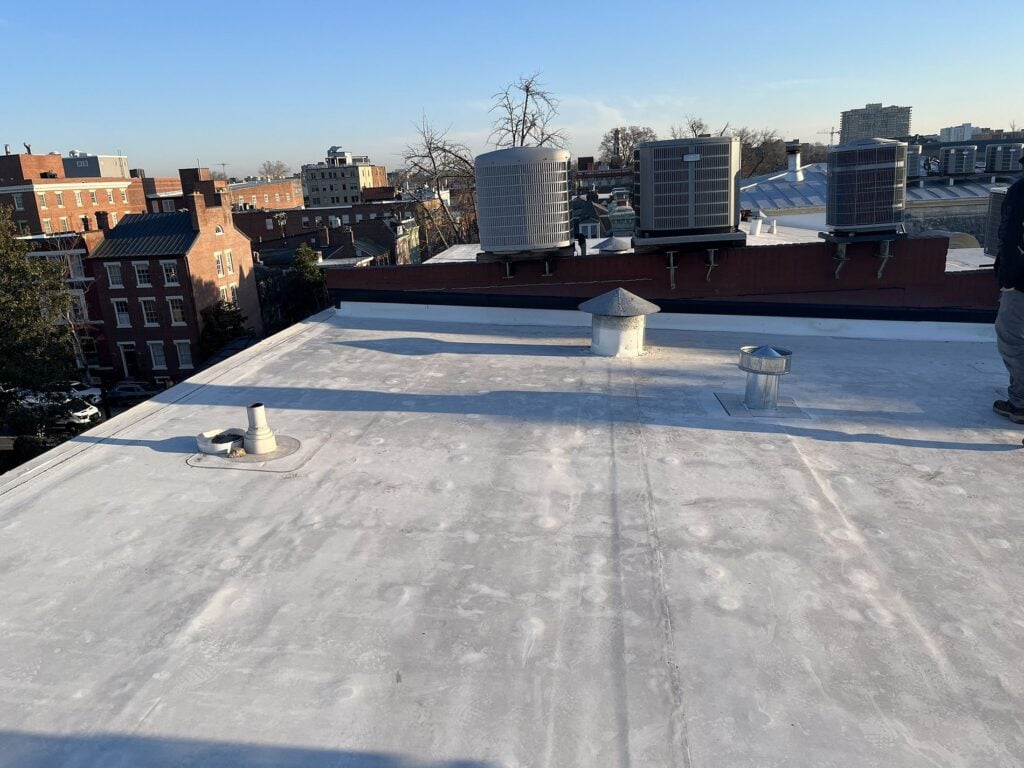
Most commercial roof failures aren’t sudden, they’re the result of small problems that went unnoticed for too long. Knowing what causes early failure helps building owners spot the warning signs.
What Are the Most Common Causes of Premature Roof Failure?
The most common causes of premature commercial roof failure are ponding water, blocked drains, failed sealants and flashings, foot traffic damage, and rooftop equipment leaks. A flat roof and other low-slope systems are especially vulnerable because water doesn’t drain on its own the way it does on a steep residential roof, and they are prone to standing water, blistering, and cracking as temperatures swing. When drains clog, water pools for days at a time, which adds weight to the structure, accelerates membrane aging, and finds every weakness in the system before small defects become major problems. Heavy foot traffic from HVAC technicians, satellite installers, and other trades is a leading cause of roof damage, creating punctures and worn spots that turn into leaks. Buildings in Manassas and surrounding areas often see all of these factors over a 20-year roof life, which is why structured maintenance pays for itself many times over.
- Ponding water: Water sitting more than 48 hours weakens membranes and adds structural load.
- Blocked drains: Leaves, dirt, and debris turn drains into water dams.
- Failed sealants: Caulk and sealant around penetrations cracks within 5 to 10 years.
- Foot traffic damage: Repeated walking on the roof punctures membranes and crushes insulation.
How Does a Lack of Maintenance Affect Roof Warranties?
A lack of maintenance affects commercial roof warranty coverage more than most building owners realize, because nearly every manufacturer warranty requires documented preventive maintenance to remain valid. Manufacturers like Carlisle, Firestone, GAF, and Johns Manville write specific requirements into their warranty terms about inspection frequency, debris removal, and documented maintenance records to preserve coverage. When a leak shows up years later and the manufacturer asks for maintenance documentation, properties without records showing the roof’s condition over time often get their warranty claim denied. That can turn a covered $40,000 roof repair into an out-of-pocket emergency. Building owners in Manassas and surrounding areas should keep written inspection records as routinely as they keep HVAC and elevator service logs.
- Documentation required: Most warranties demand written inspection records.
- Manufacturer-specific terms: Each warranty has its own maintenance requirements.
- Claim denial risk: Missing records can void coverage for legitimate failures.
- Record retention: Keep maintenance reports for the full warranty period.
7 Pillars of a Strong Commercial Roof Maintenance Plan
A serious commercial maintenance program covers seven specific areas, each addressing a known cause of premature roof failure. Together they form the standard of care that protects both the roof and the warranty behind it.
1. How Often Should a Commercial Roof Be Inspected?
A commercial roof should be inspected at least twice per year, in spring and fall, plus after any major storm, as part of routine maintenance. Spring inspections catch winter damage from ice, snow load, and freeze-thaw stress. Fall inspections clear summer debris, check seals after a season of heat, and prepare the roof for winter. Roofs older than 15 years, those with heavy foot traffic, or those carrying significant rooftop equipment may need quarterly inspections instead. Properties in Manassas and surrounding areas typically follow the twice-yearly standard. A trained inspector documents every visit with photos, notes, and a written report that becomes part of the warranty record; having the roof inspected regularly is part of a proactive approach, and regular inspections and proactive maintenance are the most effective ways to double the lifespan of a commercial roof.
- Spring inspection: Catches winter and freeze-thaw damage.
- Fall inspection: Clears summer debris and preps for winter.
- Post-storm: Extra inspections after wind, hail, or heavy snow events.
- Older roofs: Inspections quarterly once a roof is past 15 years.
2. What Does a Professional Roof Inspection Cover?
A professional commercial roof inspection covers the membrane surface, seams, flashings, drains, penetrations, edge metal, and rooftop equipment connections. The inspector walks the entire roof looking for blisters, cracks, splits, alligatoring (a dried-out pattern in older membranes), and signs of ponding water. They also check every drain for blockage, every flashing for separation, and every seam for failed adhesive or sealant. Rooftop HVAC units, vent stacks, and skylights get particular attention because penetrations are the most common leak source. A good inspection takes one to three hours depending on roof size and finishes with a written report.
- Membrane condition: Surface inspected for splits, blisters, and degradation.
- Seams and flashings: Checked for separation, sealant failure, or lifting.
- Drains and scuppers: Cleared and verified to flow freely.
- Penetrations: HVAC curbs, vents, and pipes inspected for tight seals.
3. Why Is Drain and Debris Management So Important?
Drain and debris management is the single most important maintenance task on a commercial roof because standing water causes more long-term damage than almost any other factor. Leaves, branches, and dirt collect around drain strainers and clog them within months, especially on roofs surrounded by trees. Once a drain is blocked, water can pool inches deep across large areas of the roof, adding hundreds or thousands of pounds of weight and accelerating membrane breakdown. Reputable maintenance programs include drain clearing at every visit, and properties with heavy tree cover may need monthly drain checks. Manassas and surrounding areas see this most often after fall leaf drop and spring pollen seasons.
- Drain clearing: Strainers and bowls cleared at every visit.
- Debris removal: Leaves, branches, and dirt removed from the entire roof surface.
- Scupper checks: Wall openings verified clear and flowing.
- Tree-adjacent buildings: Monthly checks during leaf-drop season.
The National Roofing Contractors Association recommends that all building owners schedule roof system inspections at least twice per year, in spring and fall, to identify problems like cracked or warped membrane, deteriorated flashings, and clogged drainage before they cause significant damage.
4. What Kind of Sealant and Flashing Work Is Required?
Sealant and flashing work on a commercial roof keeps water out at every spot where two surfaces meet or where something penetrates the roof. Caulk, polyurethane sealant, and butyl tape all break down over time from sun, heat, and movement, and neglected flashing issues left untreated can lead to costly repairs. Flashings around HVAC curbs, pipes, and walls can lift or pull away as the building settles or as thermal expansion cycles take their toll. A maintenance program catches these issues during scheduled inspections and addresses minor issues before they leak, which helps avoid major problems. A commercial roofing contractor in Manassas and surrounding areas often includes minor sealant work in standard maintenance and bills bigger flashing repairs separately.
- Sealant touch-up: Cracked or dried caulk replaced before it leaks.
- Flashing inspection: All flashings checked for separation or lifting.
- Termination bars: Wall-mounted bars checked for tight fastening.
- Pitch pockets: Filled and topped off as they shrink over time.
5. How Should Rooftop Equipment Be Managed?
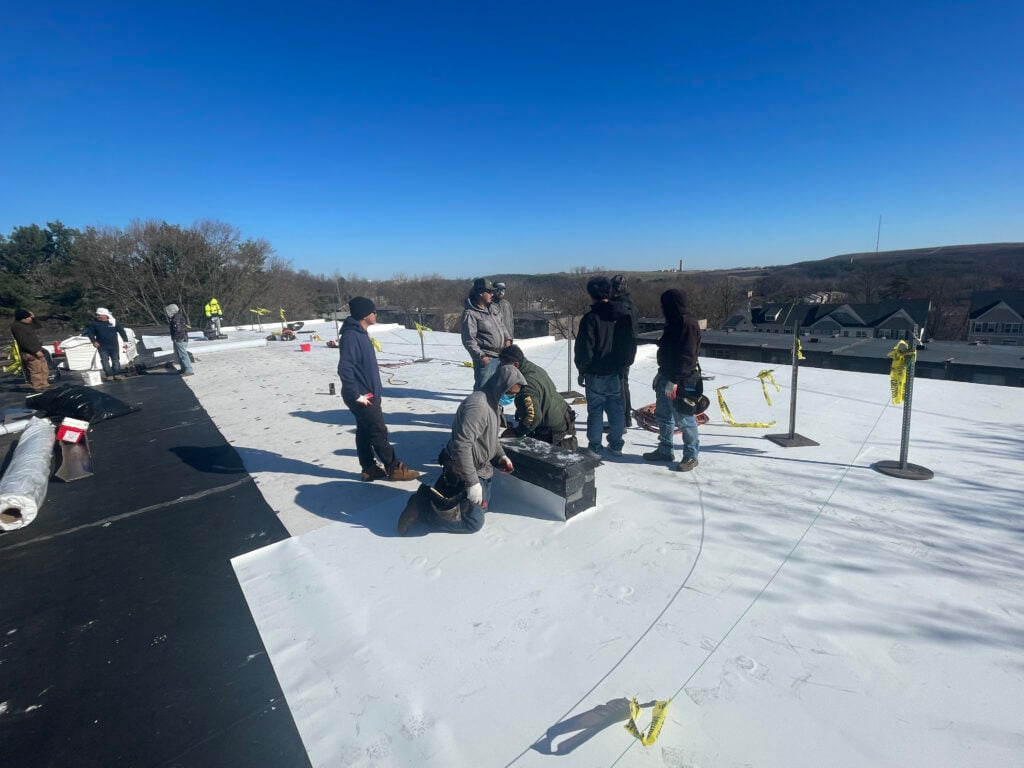
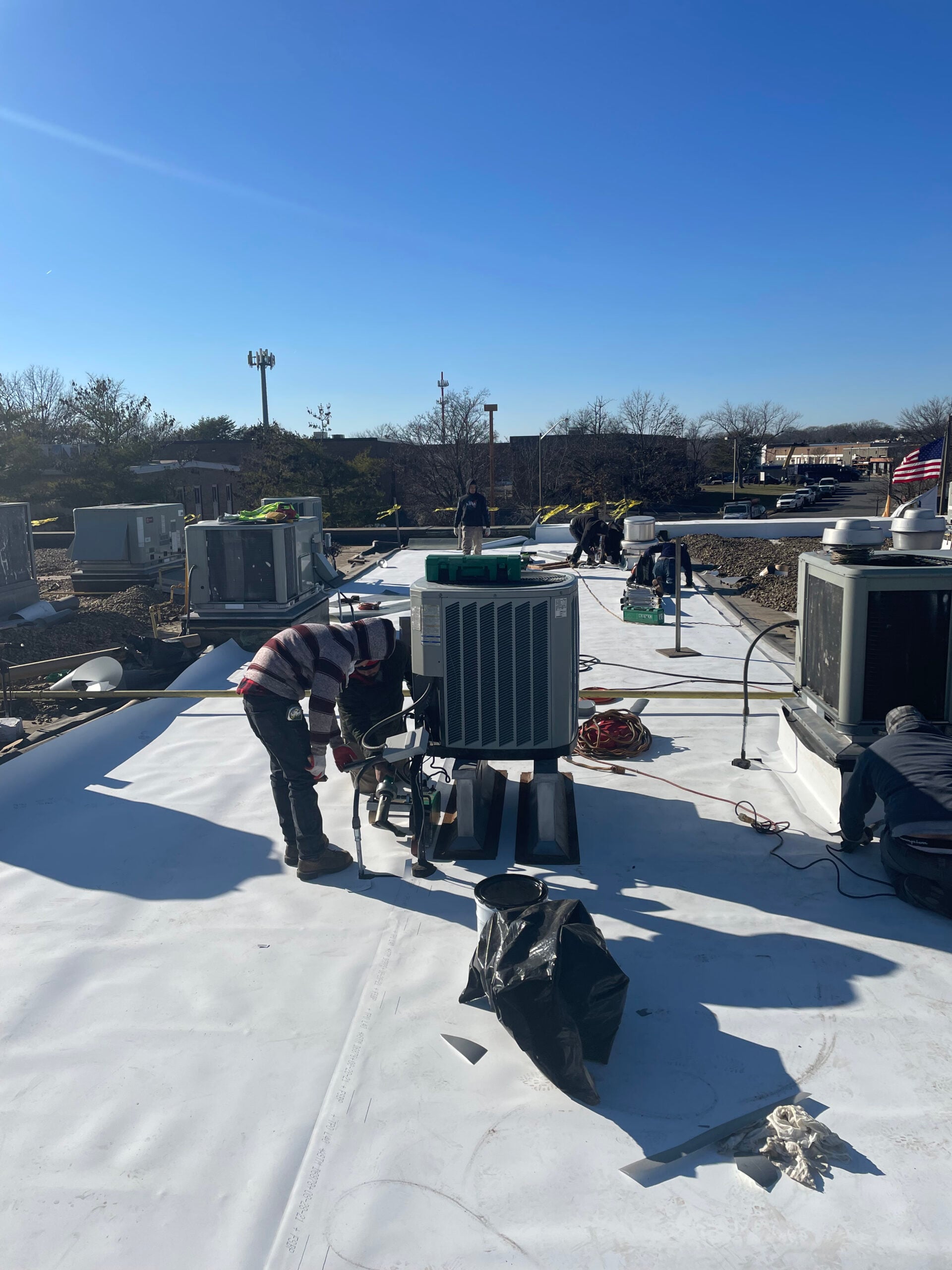
Rooftop equipment management means making sure HVAC units, exhaust fans, solar panels, and antenna mounts don’t damage the roof underneath them. Every piece of rooftop equipment sits on a curb, pad, or mount that creates a penetration through the membrane, and each of those penetrations is a potential leak point. Vibration from HVAC compressors can wear down membrane over years, and refrigerant or oil leaks from equipment can damage the roof’s surface. A maintenance program includes inspecting around every piece of rooftop equipment and noting any signs of wear or damage. Properties with solar arrays or extensive HVAC equipment need extra attention here.
- Equipment inspection: Every piece of rooftop gear checked for damage to surrounding membrane.
- Refrigerant or oil staining: Spotted and cleaned before it eats into the membrane.
- Walk pads: Installed in high-traffic service areas to protect the roof.
- Vibration check: HVAC units inspected for excessive movement or wear.
6. Why Is Documentation So Critical?
Detailed documentation is critical for commercial roof maintenance because it’s what proves the program exists in the eyes of a manufacturer warranty claim, an insurance adjuster, or a potential building buyer. Every inspection should produce a written report with photos, notes on any issues found, and recommendations for repairs, while recording developing issues and the building’s roof condition over time. Repair invoices, replacement membrane warranties, and sealant product data sheets all become part of the building’s roofing file. Without this paperwork, warranty claims years later can be denied for lack of maintenance evidence. Building owners in Manassas and surrounding areas often discover the value of these records only when they file a claim or sell the building, and the building owner should maintain them.
- Written inspection reports: Filed after every scheduled visit.
- Photo documentation: Time-stamped images of conditions and repairs.
- Repair invoices: Kept for the full warranty period.
- Maintenance log: Master file tracking every visit and action.
7. When Should Minor Repairs Become a Bigger Conversation?
Minor repairs become a bigger conversation when the same issues come up year after year, when repair costs start climbing, or when the roof reaches the back half of its expected service life. A roof needing more than two or three repairs per year is sending a signal that the system as a whole is starting to fail. At that point, a reputable contractor will recommend a roof condition assessment and a long-term capital planning conversation. Replacing a commercial roof on a planned timeline is far cheaper than reacting to a failure. Smart building owners start planning replacement at year 15 of a 20-year roof, not at year 21.
- Repeat repairs: Multiple repairs in the same year point to system-wide aging.
- Rising repair costs: Trend line that signals replacement may be more efficient.
- Roof age: Replacement planning starts at 75% of expected service life.
- Condition assessment: Full evaluation before deciding repair vs. replacement.
How to Choose a Commercial Roof Maintenance Partner
Not every roofer offers structured commercial maintenance, and the contractor you pick matters as much as the program itself. Knowing what to look for protects your building and your bottom line.
What Should Building Owners Look For in a Maintenance Contract?
Building owners should look for a maintenance contract that spells out inspection frequency, scope of work at each visit, response time for emergencies, included repairs versus billable repairs, and reporting standards. A vague contract that promises “regular maintenance” without specifics leaves both sides exposed. The contract should also reference any manufacturer warranty requirements your roof carries so the maintenance program keeps that warranty valid. Reputable commercial roofers in Manassas and surrounding areas will provide sample reports, references from similar buildings, and proof of insurance and certifications. Don’t sign a contract without these basics in writing.
- Inspection schedule: Number and timing of visits clearly defined.
- Scope per visit: What gets inspected, cleared, and reported.
- Emergency response: Guaranteed response time, ideally 24 to 48 hours.
- Included vs. billable: Clear line on what’s covered in the base fee.
How Much Should Commercial Roof Maintenance Cost?
Commercial roof maintenance typically costs $0.05 to $0.20 per square foot per year for a structured program with bi-annual inspections, drain clearing, and minor sealant work. For a 20,000 square foot building in Manassas and surrounding areas, that’s roughly $1,000 to $4,000 per year. Larger or more complex roofs, those with significant equipment, or older systems can run higher. Compared to the cost of an emergency repair (often $5,000 to $20,000) or a premature replacement (often $200,000 or more), structured maintenance pays for itself easily. Cheaper programs often skip documentation or use less experienced labor.
- Base rate: $0.05 to $0.20 per square foot per year.
- Bi-annual visits: Most programs include two scheduled inspections.
- Minor repairs: Some programs include a small repair allowance per year.
- Premium programs: Add infrared moisture scanning and warranty compliance.
Frequently Asked Questions
How long does a commercial roof typically last?
Most commercial roofing systems last 20 to 30 years with proper maintenance, though specific lifespans vary by membrane type. TPO and EPDM roofs typically last 20 to 25 years, modified bitumen 20 years, and built-up roofs 20 to 30 years. Without maintenance, expected life drops by 30% to 40%.
Can I do commercial roof maintenance myself?
Commercial roof maintenance is not a job for in-house facility staff because of safety risk, technical training, and warranty requirements. Most manufacturer warranties specifically require maintenance by qualified contractors, and DIY work can void coverage. Trained inspectors also spot problems that untrained eyes miss.
What does an emergency roof leak repair cost?
Emergency commercial roof leak repairs typically cost $1,500 to $10,000 depending on size, location, and time of day, with after-hours and weekend calls running higher. Water damage to interior contents, ceiling tiles, and equipment can multiply that cost many times over. Preventive maintenance keeps most emergencies from happening in the first place.
Will roof maintenance keep my warranty valid?
Yes, scheduled commercial roof maintenance is typically required to keep manufacturer warranties valid. Most manufacturers require documented inspections at least once a year, with twice a year being the industry standard. Skipping maintenance is one of the most common reasons warranty claims get denied.
How do I know if my commercial roof needs replacement?
Signs a commercial roof needs replacement include widespread membrane cracking, repeat leaks across multiple areas, large areas of ponding water that won’t drain, wet insulation showing on infrared scans, and roof age past 20 years. A professional condition assessment is the best way to evaluate repair versus replacement.
What’s the best time of year for commercial roof work?
The best time for commercial roof work in Manassas and surrounding areas is late spring through early fall, when temperatures support proper membrane adhesion and there’s lower risk of weather delays. Maintenance inspections can happen year-round, but major repairs and replacements are usually scheduled between April and October.
Choose Springfield Roofing & Sheet Metal for Commercial Roof Maintenance That Lasts
When commercial roofing maintenance is done right, building owners avoid the surprise expenses, voided warranties, and tenant disruptions that come with premature roof failure. Springfield Roofing & Sheet Metal is a 1st and 2nd generation family-owned and operated company serving Manassas and surrounding areas with a dedicated in-house crew, full labor and material warranties, and CertainTeed 5-Star Select Shingle Master certification, which is held by only a small percentage of roofing contractors nationwide. We provide structured commercial maintenance programs with scheduled inspections, written reports, and clear pricing so you know exactly what you’re paying for and what’s being protected. Contact Springfield Roofing & Sheet Metal today for a free commercial roof assessment and find out what a real maintenance program does for your building.